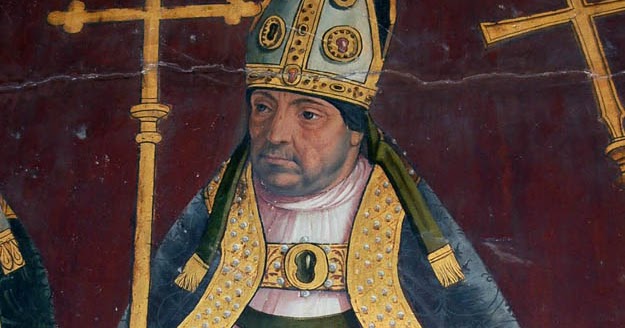
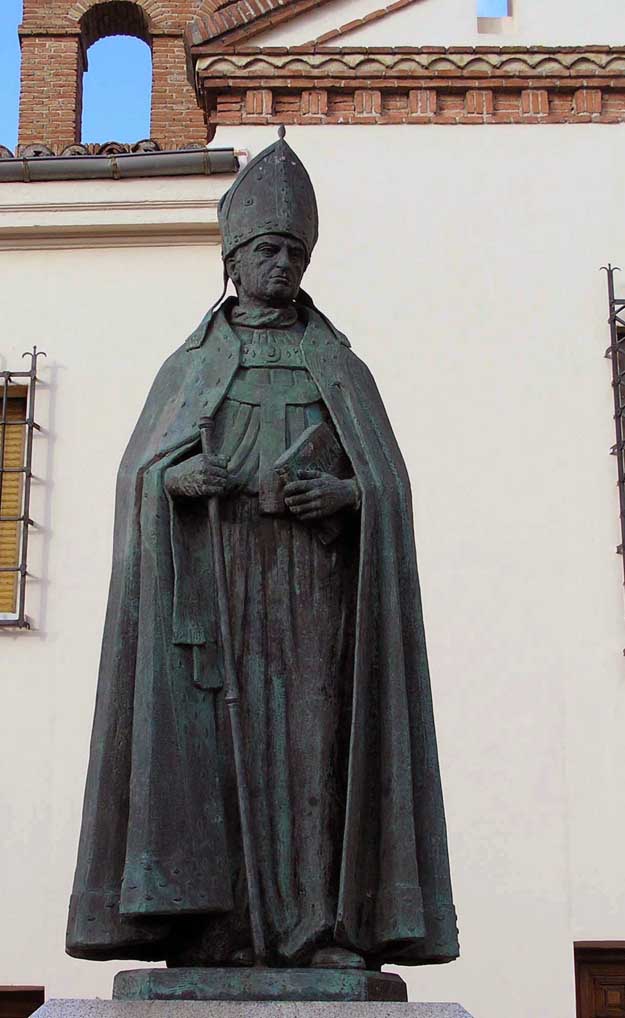
Alfonso Carrillo
Alfonso Carrillo de Acuña (Carrascosa del Campo, 11 August 1413 – Alcalá de Henares, 1 July 1482) played an important role in politics during Isabel’s lifetime. He was appointed archbishop of Toledo in 1446. His influence on political life during the reigns of Juan II, Enrique IV, and Isabel was enormous; his positions were highly variable, always adapting to the circumstances.
After the execution of Álvaro de Luna in 1453, he supported his nephew Juan Pacheco, favourite of King Enrique IV, and carried out diplomatic missions with France, through which he gained great power. His greed and ambition led to a confrontation with the king from the moment the latter chose Beltrán de la Cueva at Pacheco’s expense, thereby siding with the Mendoza clan, arch‑enemies of Carrillo. From 1462 he was the principal instigator of a band of Castilians who sought to dethrone the king and replace him with his half‑brother Alfonso, and he took an active part in the Farsa de Ávila in 1465. This led to a long and bloody civil war in Castile. After Alfonso died in the summer of 1468, possibly poisoned by Pacheco, Isabel became a candidate for the throne, while Carrillo became her chief adviser, who, together with Pierres de Peralta, played an important role in arranging the marriage between Isabel and Fernando.
When the Catholic Monarchs came to power after the death of Enrique IV, his interest began to decline. Carrillo did not accept their authoritarian behaviour, but it was above all the appointment of Pedro González de Mendoza — Carrillo’s old enemy — as cardinal, a position he had coveted for himself, that prompted him to turn away from the Monarchs.
This radical reversal caused Carrillo to side with King Juan de Portugal, who defended the rights of his niece Juana in the Querra de Sucesión (War of Succession). It was a long and bloody war, but in early 1479 an offensive by the Catholic Monarchs definitively defeated the Portuguese, and Carrillo was forced to submit.