
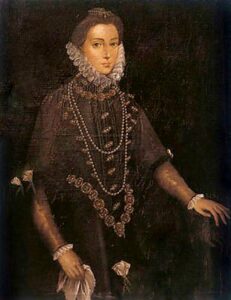
 Beatriz de Bobadilla y Maldonado, later known as the Marquesa de Moya, was born around 1440 in Medina del Campo and died on 17 January 1511 in Madrid. She was one of the closest confidantes of Queen Isabel I of Castile and played an important role in the political and social networks surrounding the royal court. She was the daughter of Pedro de Bobadilla, castellan of the Castle of Maqueda and the Alcázar of Segovia, and Isabel González Maldonado. The Bobadilla and Maldonado families belonged to the established Castilian nobility, with strong ties to the court.
The friendship between Beatriz and the young Isabel likely began in Arévalo, where both spent part of their childhood. In an environment marked by political uncertainty and intrigue, a close relationship developed between them — a bond of trust that became the foundation of lifelong personal and political loyalty.
Beatriz married Andrés Cabrera, an influential courtier who rose under King Enrique IV to become treasurer of Castile. The couple had nine children. In 1480, Beatriz and Andrés were rewarded for their loyalty during the succession war with the Marquesado de Moya and the lordship of Chinchón — one of the most prestigious titles Isabel could bestow.
Beatriz played an active role in the struggle for the Castilian throne. She and her husband chose Isabel’s side early and decisively, which proved crucial in a period when the nobility was deeply divided.
During the War of Granada, Beatriz remained close to the queen. During the siege of Málaga, she was stabbed by an attacker who mistook her for the queen — an incident frequently cited in contemporary chronicles as evidence of her closeness to Isabel.
Beatriz was known for her determination, sharp intellect, and loyalty. Her influence at court was considerable:
- she mediated in political matters
- she served as Isabel’s trusted confidante
- she played a role in reorganizing the court after Isabel’s accession
- she and Andrés administered the Alcázar of Segovia, a strategically important fortress
After Isabel’s death in 1504 and Fernando’s departure from Castile, Beatriz and Andrés withdrew from court life. They handed over the Alcázar of Segovia to the Señor de Belmonte, in the service of Felipe el Hermoso (Philip the Handsome). Although Fernando later returned as regent for his daughter Juana, Beatriz and Andrés — by then elderly — did not return to court.
Beatriz died in 1511, leaving behind a reputation as one of the most influential women of Isabel’s reign: loyal, courageous, and politically astute.